
The best Viking miniatures ever made? Footsore's 28mm range reviewed
When Footsore Miniatures launched their Viking Kickstarter featuring Matthew Bickley's sculpts, I broke my self-imposed "No Kickstarters" rule - and I'm glad I did. But do they live up to Footsore's bold claim of being "probably the best ever made"?
If you hadn’t already guessed it, I am a massive fan of Matthew Bickleys sculpting. So when Footsore Miniatures once again created a Kickstarter filled with Matt’s sculpts I had to break my “No Kickstarters” rule.
And I was again proven how silly that rule is.
Cnut’s Danish shieldwall prepares to receive a charge from Edmund Ironside’s Saxons. Battle of Sherston, England, June 25, 1016.
Who else sculpts like this!?
The Kickstarter was very straightforward with just as many northmen as Footsore could put in there. They also made the bold statement that the miniatures were “probably the best Vikings ever made”. Hard to resist so I went for the largest pledge which - with room for calculation errors - gave me 114 unique miniatures, enough to conquer England and keep me busy for a few months.
Scope of the range
What Vikings, or Scandinavians, wore and when is a complex question without a whole lot of answers unfortunately. The Viking period seems to fall between two periods where we have fairly good sources. Right before the Viking age, around the 6th-8th century, we have the Vendel period with amazing finds in Vendel and Valsgärde in Sweden. Towards the end of the period, the 11th century and beyond, we also have many good pictorial sources, not least the Bayeux tapestry. For the odd 400 years in between we are not so fortunate. The Sagas gives us some insight but most of them were written down centuries after our period. Warriors are depicted on runestones but they are limited in what they portray and the archeological finds are few.
So how do the miniatures compare against the few sources we have?
From left to right: The Gjermundbu helmet, chainmail found at Gjermundbu and Harolds huscarls at the battle of Hastings, wearing nasal helmets, long chainmail and round shields. Source: Wikimedia/Wolfmann, Université de Caen Normandie
Many of the helmets are in the style of the Gjermundbu and the Yarm helmet, from the 9th and 10th centuries. These types of “spectacle helmets” have become a common visual cue for Vikings although their use was probably very limited. Even by the beginning of our period simple nasal or conical helmets would have been more common. You could also argue that the most common Viking helmet would have been none at all, after all only two have ever been found. As for the armour the miniatures seem to wear, broadly speaking, two variants. One is almost the size of a modern t-shirt which corresponds to the chainmail found at Gjermundbu pictured above. The other type is much more comprehensive and reaches down to the miniature's knee. In the Heimskringla saga Harald Hardrada is described as wearing a mail shirt that reaches below his knees, so this seems appropriate too. The use of different weapons by the miniatures is nice to see with plenty of variants of both axes, swords and spears. The number of archers included is especially nice as archery seems to have been an important part of Viking warfare and frequently mentioned in the sagas.

How to shoot like a Viking (No, not like that!)
Turns out pretty much everything I thought I knew about Viking archery is wrong. We are used to seeing archers pull the bowstring back to their face using three fingers – but according to new research that is not how Vikings fired their bows.
Researcher Kim Hjardar and archer Lars Andersen have looked at everything from the Bayeux Tapestry to runestones, and the evidence is overwhelming: Vikings used a low draw to the chest or stomach, held the arrow with a thumb grip (pinch grip), and placed the arrow on the right side of the bow. Archaeological finds show Viking arrows had specially shaped nocks with grooves which with the historical pinch grip they increased drawing power by 40%.
So it turns out that all those images we've been looking at for years weren't stylized or simplified drawings – they were showing exactly how it was done. The Vikings shot fast, accurately, and completely different from the English longbowmen from a few centuries later.
Have a look at this video for more about this exciting new research.
One thing I think is a shame and a missed opportunity is that none of the warriors are wearing quilted and padded leather jerkins. Ian Heath talks about such armour in his “Armies of the Dark Ages” and there are mentions of it in the sagas. Some of the miniatures in Footsores Welsh range wear this and it might have given this range a slightly more unique look.
There are some odd choices of clothing among the miniatures though. A few have coats with what looks like lace around the buttons, these look more like 16th century russian streltsy than Vikings to me. The Vendel-era helmets look a bit anachronistic to me even though it is possible that such helmets were still in use.
The sculpting
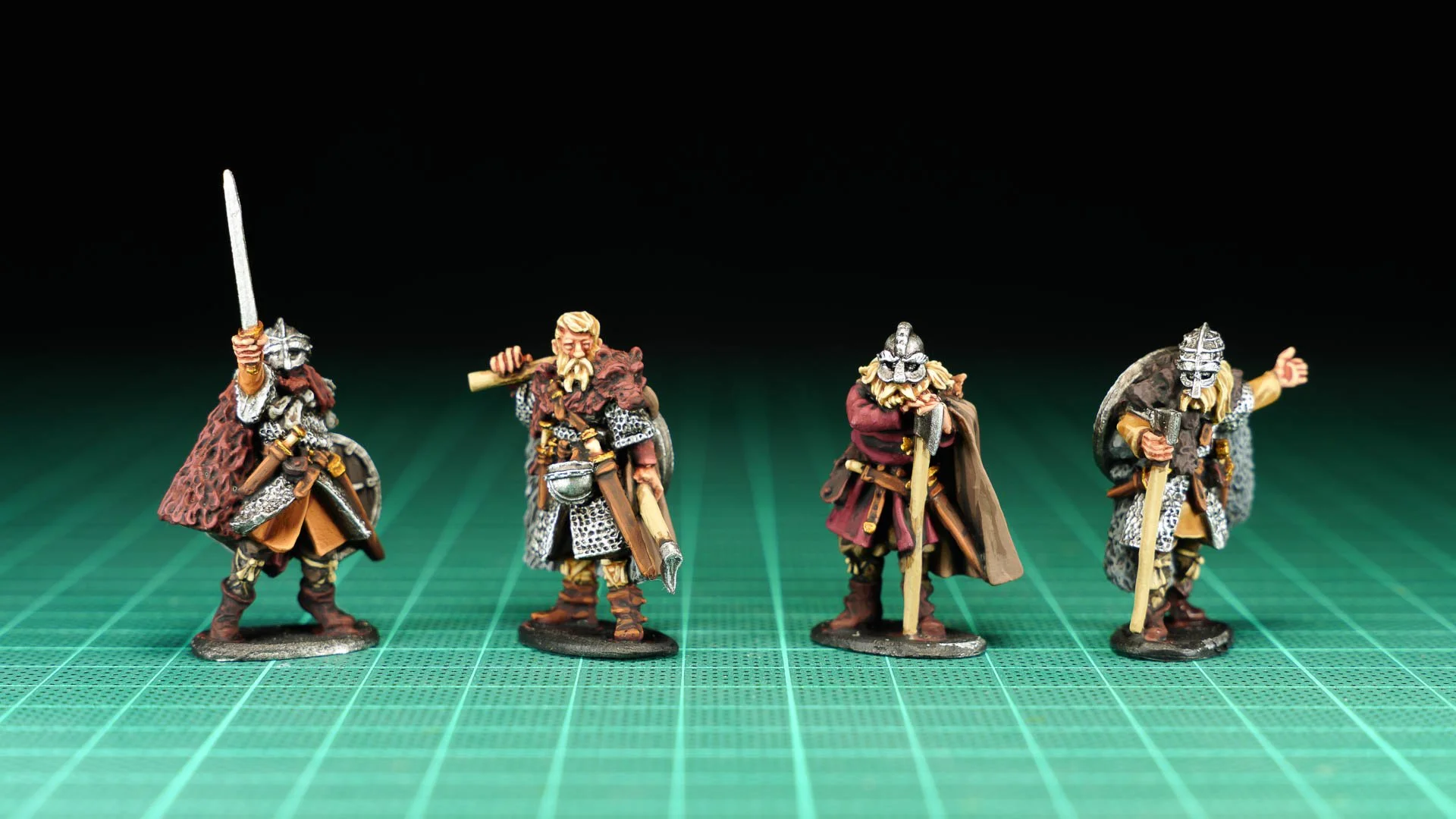
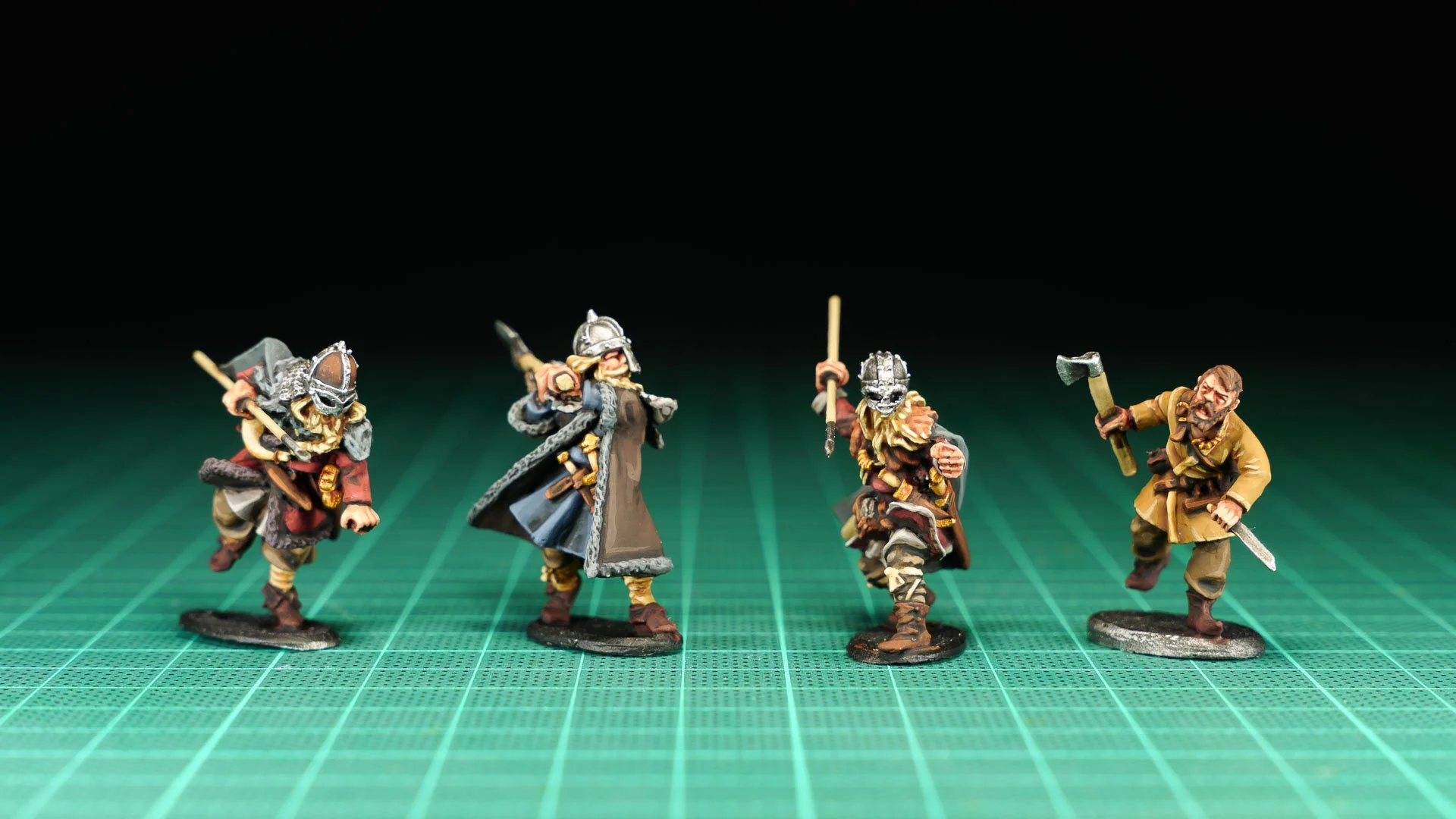
Two things mark out Matthew Bickleys sculpting in my opinion and these are the exaggerated animation in the miniature and the amount of detail which he adds to them. I say exaggerated because these miniatures are not just chopping with an axe, they are using every muscle in their body to put as much force as possible behind the swing of a few kilos of sharpened steel axe head. You can see this movement, force and animation throughout the whole miniature. I think there is less animation in the Vikings than there is in the Welsh but about as much as in the Anglo-Saxons also released by Footsore and sculpted by Matt.
The sculpted arrows certainly add a lot of realism to these miniatures.
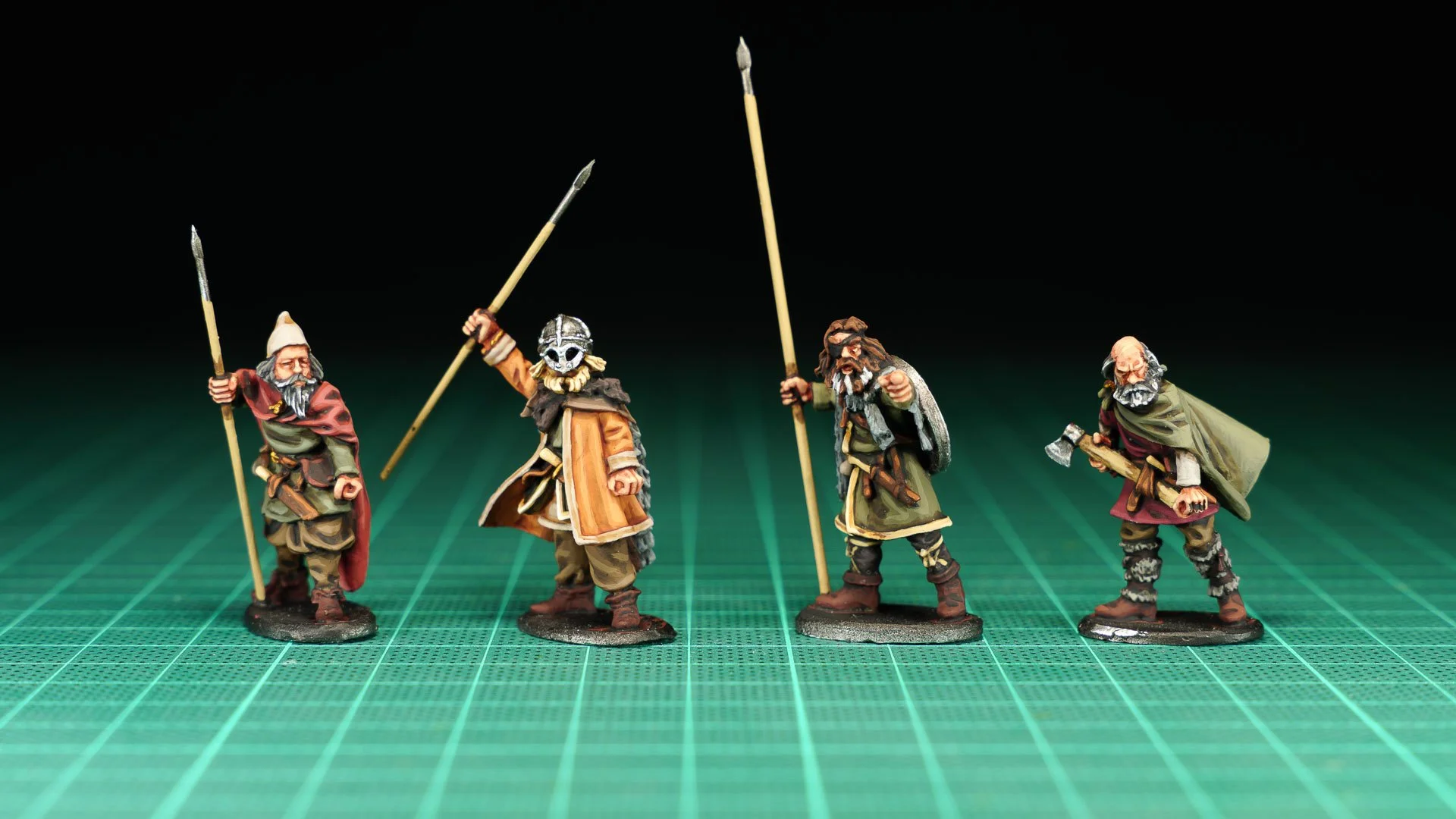
The amount of detail crammed into these miniatures are amazing. There are straps and belt buckles and necklaces with Thor’s hammer and ornamented sword hilts and braided beards and pouches and gold bracelets. You get the idea. All of this is sculpted to the highest standard possible.
Some of my favourites of the sculpts are the archers as they look like they are sneaking around at the back of the shieldwall waiting for an opportunity to let loose an arrow at an exposed enemy.
Working with the miniatures
As with all metal miniatures these required some scraping and filing. The casting quality was generally good with a few exceptions, but that’s expected, especially in complex miniatures like these. A small thing I appreciate is that there are small dents in the closed hands which makes it easier to find a good place to drill.
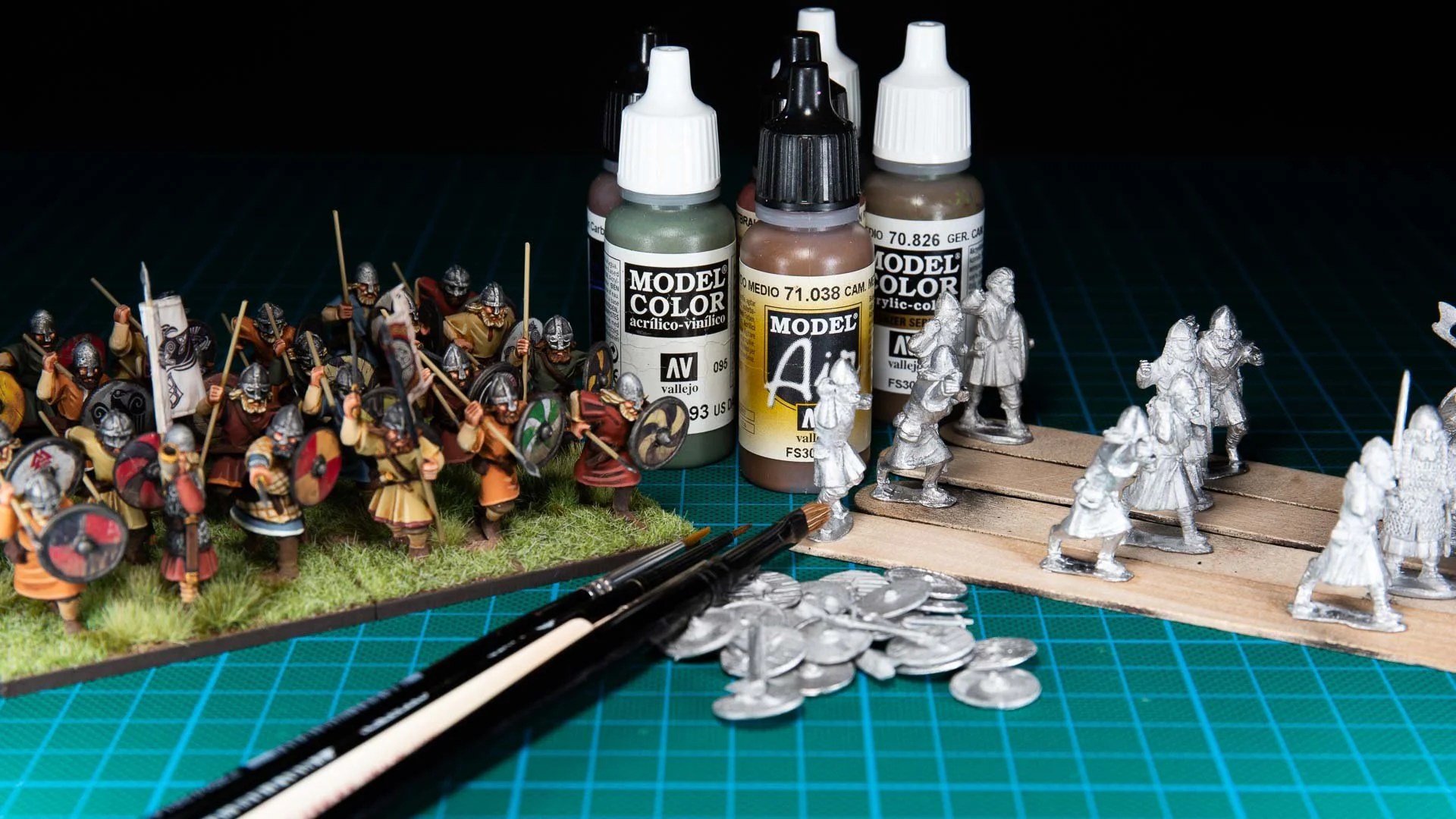
Usually when I paint miniatures I use a grid-teqnique as I have written about here: How to batch paint some furious northmen. With these miniatures though that didn’t really work as there are so many details, cloaks and furs that there just isn’t enough colours in the grid. Because I am very meticulous (or oversensitive) when it comes to colour choices I had to have contrasting colours for the cloaks and the furs too which resulted in me using more than 30 different colours on the miniatures.
All the details and the number of paints resulted in it taking quite a long time to paint these. I like painting miniatures, especially these sculpts, but there were some days when it felt like I didn’t get anywhere. Can’t really fault the miniatures for that and when I look at the end result I think every minute spent painting these were worth it.
Price
I got my miniatures through a Kickstarter which usually means you get them at a great price. I paid £185 for 144 miniatures which means around £1,3 per miniature. With inflation, tariffs and global trade being what they are we should also remember that this was almost two years ago.
These miniatures went on general release just before summer 2025 over at Footsore miniatures and today packs of four miniatures cost £10, so £2,5 each. Some miniatures are sold as singles and these cost £5.
In comparison Warlord Games sell Vikings in packs of eight miniatures for £18, so £2,25 each. Or Crusader Miniatures sell packs of four miniatures for £11,50 so £2,8 for each miniature. Gripping Beast Miniatures Vikings are £7,50 for four miniatures, so £1,8 each. Gripping Beast also sell Ragnarok Miniatures Vikings which are £14 for six miniatures so £2,3 each..
All of the above are metal miniatures which are obviously more expensive than their plastic counterparts. For example 60 Victrix Miniatures Vikings cost £35 which is just £0,58 each.
Some of the finished bases, a total of 71 miniatures so I still have quite a few left to paint.
Conclusion
The tag-line in the promotional pictures of this range was “probably the best ever made”. Besides being a wordplay on some very good Danish beer, that's a pretty bold statement. There are plenty of Viking miniatures out there and even though you could argue this is an over saturated part of the market I am sure many more are to come.
But with sculpts like these I think Footsore and Matt Bickely comfortably can strike out the “probably” in their tag-line.
An argument between two jarls. Somewhere south of Jórvík, Northumbria, 951.
I’ve added a lot more photos of these wonderful miniatures over in the Dark Age gallery so head over there if you would like to see some more!
These Welsh are a joy to paint so here is a quick guide on how I painted mine trying to do the most of these beautiful sculpts.